
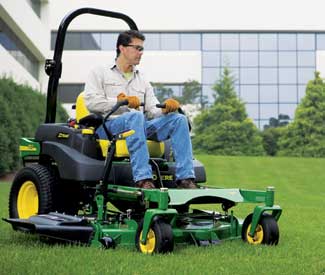
Grounds managers or superintendents of large properties, university campuses or city parts, for example, do a lot of mowing. Such properties demand the job be done properly and the cut provide a manicured look. The super and his crew take pains to make sure the grounds are immaculate. The right mower(s) for the job is essential, but what are the consideration when buying new mowers?
In the Aug. 2006 School and Campus issue, we profiled Jim Coffey, the superintendent at the Wake Forest campus in Winston-Salem, N.C. He has directed the landscape management for 21 years. The Professional Grounds Management Society honored the grounds maintenance at Wake Forest in 2004 with its highest tribute, the Green Star Grand Award. Coffey has about 138 acres of turf to deal with and has some advice on buying new mowers that I think is worth sharing.
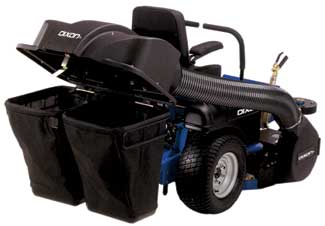
Two get a second opinion, I spoke with Sean Sundberg, John DeereÕs lawn and garden product manager.
You may be saying, ÒI know this is about buying new mowers, but what about buying used?Ó
According to Coffey: Purchasing new equipment will, of course, cost more initially, but will give you more reliable service. Reliability means getting the job done. Moreover, the price of a mower over its lifetime may be as little as 10 percent of the lifetime cost.
According to Sundberg: ÒIf you buy used youÕd better have a good relationship with the company or person selling you the equipment, otherwise you might be stuck with a mower that wonÕt consistently get the job done.Ó Universities and other large facilities like to show themselves in the best light. An old, dilapidated mower putting around campus doesnÕt say, ÒThis is where I want my child to attend college,Ó but more, ÒThis school canÕt even afford a decent piece of equipment.Ó
According to Coffey: ÒNever select equipment without the aid of the turf crew leader, the primary operator and the mechanic.Ó


Coffey has the experience to select mowers, but, after all, he isnÕt the one who will climb aboard or walk behind the mower as it cuts the grass. His turf crew leader knows what works best for particular jobs, but his crew needs to feel comfortable operating the equipment. Mike Fulk is the mechanic for the landscape department at Wake Forest. Coffey isnÕt going to purchase a mower unless Fulk gives the thumbs up.
According to Sundberg: I couldnÕt agree more. His approach is the right one, empowering his people in the purchasing decisions. Sundberg knows first-hand of purchasing agents buying mowers without any feedback from the people who will operate the equipment. If you are adding a mower or two to your facility, you have the clout as a customer of a large property to have several manufacturers bring out models for your crews to try out to make sure they are comfortable with the new mowers and your facility is getting the proper equipment to meet your needs.
According to Coffey: Reel mowers are often the best choice for areas requiring frequent cutting. They cut cleanly and evenly when properly adjusted. Their maintenance and power requirements are relatively low and they can be used in gangs for large areas. Reel mowers can only cut short vegetation, however.
According to Sundberg: ÒReel mowers (blades moving in a circular motion) are best for golf courses and other finely manicured turf, including sports fields and anywhere that grass needs to be kept short.Ó
Chris Burrows the grounds manager for the Pinehurst Resort (see ÒAlways Something to DoÓ Jan. 2006 LSMP and at landscapeonline.com) uses eight reel mowers on their golf courses, but he doesnÕt use them for the grounds. They donÕt give him the clean cut heÕs looking for, and his crews donÕt like using them. ÒIf you hit a root it trashes the mower,Ó he says.
According to Coffey: Rotary mowers can provide a variety of cuts, from short and tall grasses to light brush. Their maintenance cost are relatively low. Their power requirement, however, is higher than other mowers and they tend to throw small objects, which can create a safety hazard in some areas.
According to Sundberg: ÒA rotary mower is typically a zeo-turn machine with a mower deck underneath. In John Deere lingo a rotary cutter has a big deck and is pulled off the back of a tractor to Ôbeat the brush.Õ There is less maintenance on these mowers but because they are bigger, they are going to draw more horsepower. A six-foot cutter is going to need a tractor with 25-30 hp to run it effectively. John Deere cutters have safety chains that keep debris under the deck where it belongs.Ó
According to Coffey: Sickle-bar mowers are suitable for areas that require infrequent mowings. Because of their intended use, the maintenance and power requirements are greater than those of other mowers. If there is a need to mow coarse grasses, embankments or large open areas that require a mowing height of three inches or better, consider this type of mower. For areas that have a rough terrain incorporated with rocks, samplings, tree limbs and weeds, consider a cylinder-hammer type mower. It requires a great deal of power, but they work will in wooded areas that need occasional mowing. They pulverize materials into a fine mulch that is good for soil protection.
According to Sundberg: ÒThe sickle-bar mower is pulled by a tractor off to the side with a sickle-shaped cutter for rough cutting. ItÕs almost like a hedge trimmer. ItÕs good for working through an area where you want to knock stuff down but without a high-cut quality.Ó
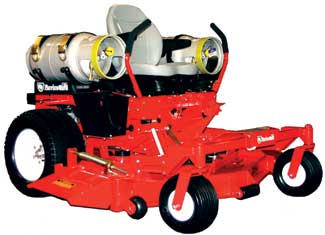
Sundberg had not heard the term Òcylinder-hammerÓ but figured it was synonymous with flails mower, which is a tractor-pulled three-bank deck, counterbalanced rotor equipped with 36 individually replaceable knives that shred and pulverize.
According to Coffey: With front-mount compact mowers you can choose from a range of mowing decks: mulching rear discharge, side discharge and those that can add the feature of grass collection. An option of four-wheel drive also provides mobility to work slopes and slippery conditions. ÒAlso consider a unit that has the maneuverability to turn a tight radius. This is especially useful in confined areas, eliminating secondary grooming and is helpful in working around tree rings, flower beds, etc.Ó
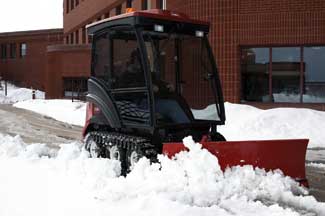
According to Sundberg: ÒWe have front mowers that typically go to universities, big traction units with 72-in. mower decks and two rear wheels that pivot to steer. You get good cut quality and trim ability. You donÕt have to go back and touch up. You donÕt need someone with weed whackers or walk-behind mowers to clean up. They are fast. You can peddle a lot of grass. ItÕs the same deck we have on our zero-turn machines, just on an enlarged scale.
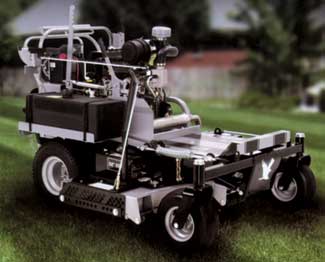
You can put snow throwers on them, blades on them, wide collections systems, etc. ThereÕs not much that beats a front mower for getting rid of snow.Ó
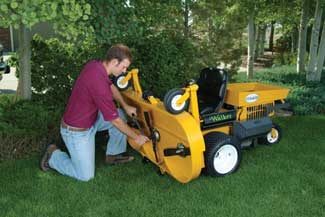
According to Coffey: For commercial walk-behinds (big decks) look for ease of maintenance, operator comfort, maneuverability and safety features. Select a unit that offers the ability to control speed and steering without moving your hands from the bar. Choose a unit that has a floating deck available in several sizes with options that let you mulch, side discharge or collect clippings.
According to Sundberg: ÒThe trend in the industry is toward the zero-turn ride-ons. But everyone has a need for a commercial walk-behind for those areas you canÕt get to with the ride-on, or for a steep hill. For safety, you want a machine that you can operate by keeping your hands on the trips. There are some that are more confusing to operate than ride-on machines. Once you learn how to use them you can be very productive, but it can take a bit of time to get comfortable operating them.Ó Sundberg concurs that the unit should have a floating deck to handle uneven terrain.
According to Coffey: When buying new equipment ask the sales rep. for a free tool kit to help maintain the equipment, training and maintenance guidelines for the operator and mechanic and extra parts (belts, for example).
According to Sundberg: Most dealers will not have a free tool kit. Most dealers are more than willing to provide safety and operational training. They will want to know who is going to do the preventative maintenance and in-house service of the machine. They will make sure the service person is up to speed.
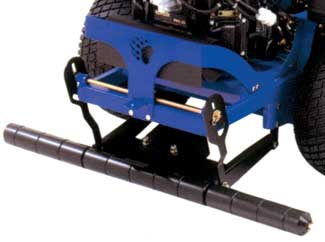
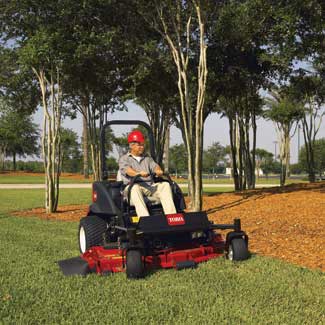
Other than its maneuverability, why the trend to zero-turn? Sundberg states several reasons: They are easy to operate (only two sticks on the machine); you can get large decks (72-inch); they mow fast; have excellent cut quality; and the price is a bit less the some of the large front mowers. Sundberg notes, however, that with very heavy use, the zero-turn wonÕt last as long and you may not get the trade-in value you anticipated.
ÒWeÕve seem some institutions who do large-scale mowing that tried zero-turn machines come back to the front mower. They do last longer and have fewer issue. The up-front cost is more, but you get a better return on your investment.Ó
According to Sundberg, some mower manufacturers do not hold themselves to the same safety standards as the bigger manufacturers. He suggests asking these safety questions before purchasing a mower:
