
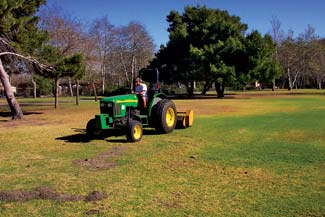
100 acres of turfgrass is a chore to mow, and an army of gophers and burrowing squirrels doesnÕt make the job easier.
An hour south of Los Angeles, Huntington Beach is better-known for its waves and beaches than its inland parks. Bird enthusiasts flock to the coast there, but no one would suggest that this city of about 200,000 people is a spot for prime wildlife viewing.
ButÑas elsewhereÑitÕs a different story when youÕre up early most mornings. Parks maintenance supervisor Ron Foreman has his share of tales about suburban sightingsÑof fox, raccoon and other creatures.
ÒEarly in the morning itÕs so quietÑa lot of people miss this stuff,Ó Foreman said recently. ÒOne day I saw this bird fly into the pond. I though it had a death-wish. Then I saw him fly out with a 10-inch trout.Ó The bird was an osprey, which had snagged a fish (planted by U.S. Fish and Game) in the cityÕs Chris Carr Park. As most Landscape Superintendents can attest, working outdoors has its advantages.
Several of Huntington BeachÕs almost 70 parks have ponds stocked with trout and other fish. The biggest is a former gravel pit that, in 1974, became Huntington Lake when the city dedicated Huntington Central Park. Like its New York City namesake, the park was designed with a mix of trees, shrubs, foliage and open lawns.
The park is laid out in two blocks that are divided by Golden West Street, one of the cityÕs main thoroughfares. The city maintenance lot is located at the northeast corner, giving crews easy access to the parkÕs 195 acres. Of that total, close to 100 acres is nearly-level turfgrass that requires mowing once a week in summer and once every two weeks in the cool season (the temperature rarely dips below 45 degrees F in the coastal town).
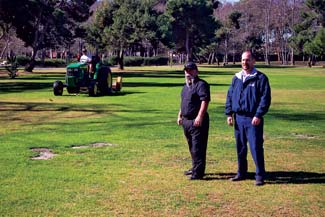
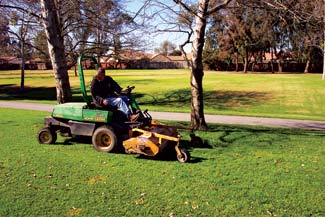
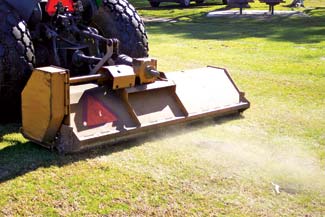
Not surprisingly, the crew spends more time mowing than on any other single task at the park. An 80-inch Vrisimo flail deck attached to a John Deere tractor takes care of the open areas but lacks agility around trees and shrubs. In tighter spaces, workers rely on John Deere front-end mowers with 54-inch blades. Crews usually mow for five or six hours a day to finish mowing the park. It takes about a week for the crew to mow the 100-acre park.
ItÕs a big job, but thereÕs no race to reach the finish line, crew leader Ron Kilbourne said. ÒIf you go too fast, you get a ripple effect,Ó he explained. ÒWe have to keep (the John Deere tractor) in second gear to avoid that.Ó
The mow crew works during the week to avoid high-use periods, and coordinates work to avoid interfering with groups using picnic areas and other facilities.
Central ParkÕs turf is a patchwork quilt composed mainly of Bermudagrass, with naturally-occurring cool-season turf springing up during winter rains.
Bermudagrass is cut at a height of 1.5 inches. Several areas are seeded with Kentucky bluegrass, which is cut at close to two inches. The city planted its nearby sports park recently with seashore paspalum and reports good results; paspalum is also used in turf areas near the cityÕs beach where it holds up well against the salt spray.
Granular fertilizer is applied twice a year. The most important application is in April, to prime the turf for warm-season growth. The crew also puts down fertilizer in the fallÑboth applications are a three-month, slow-release product.
Workers do not apply pre-emergents or other herbicides in an attempt to keep Bermudagrass from areas, say, originally planted with kikuya. The crew takes a pragmatic approach.
ÒWe canÕt stop it, so why fight it,Ó Kilbourne said. ÒTo fight it is a losing battle.Ó
Huntington Beach has a separate crew that handles tree trimming and other maintenance. The tree crew generates tons of mulch annually that the park grounds crew applies to beds for weed-suppression and water-retention. The grounds crew does deal with moderate leaf fall from the parkÕs California sycamores. Debris from pine trees is a bigger problem as it interferes with mowers. Eucalyptus trees also require significant time for debris clean-up.
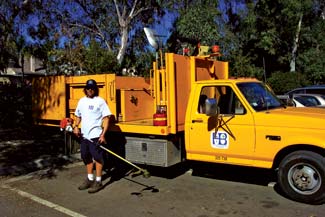
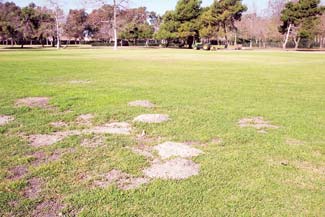
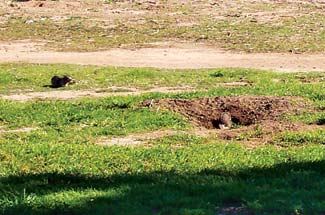
Like Bill MurrayÕs character in ÒCaddyshack,Ó the Central Park crew is dogged by gophers that mar the turf with piles of soil. Much of the damage is caused by burrowing squirrels that have turned the parkÕs Frisbee golf course into a colony. Rabbits are another problem.
Years ago, the city used chemical bait to keep populations downÑit did away with that program two years ago. Aggressive pest control for furry creatures can generate citizen complaints.
ÒPeople donÕt want to see them spitting and kicking all over the grounds,Ó supervisor Ron Foreman said.
Now the city calls in a licensed pest-control contractor when the rodent population runs out of control. Other pesticidesÑfor mosquitoesÑare put down by the County of OrangeÕs vector control department.
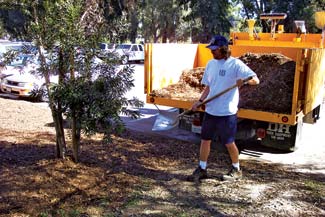
Like other communities across the country, Huntington Beach lives with budget cuts that restrict hiring and limit equipment budgets. Supervisor Ron Foreman cautions against the impulse to save on hardwareÑwhich can end up costing more in the long run. Similarly, buying the best is important when youÕre doing hundreds of hours of work between maintenance cycles.
ÒWe try to standardize our equipment so we donÕt have to deal with dozens of different parts and tools,Ó Foreman said. ÒWe use top-quality and heavy-duty. It makes sense to spend more at first, because in the long run, with maintenance, you actually end up spending more. And if you count the man-hours you lose from downtime, it just doesnÕt make sense.Ó
More on Huntington Beach: www.surfcity-hb.org
