
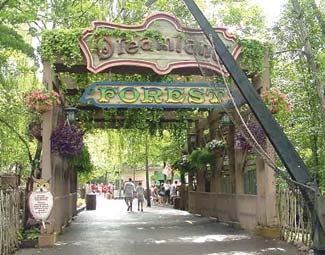
Dollywood, a Great Smoky Mountain Heritage Park in Pigeon Forge, Tennessee has woodcarving, glass blowing, candle making, soap making, a functional carriage works, a blacksmith shop, a sawmill and a lumber campÑjust to name a fewÑplus rides, shops and churches, all scattered through eight themed areas on 125 acres, and thatÕs a lot to take care of.
Pat Edmonds is DollywoodÕs Landscape Supervisor, and she manages all the work along with John White, Director of Maintenance and Construction. With a total crew of 21 in the landscape division, they take exquisite care of the 125 developed acres of this beautiful Victorian style amusement park in Tennessee. In addition to the developed acreage, there are also 500 undeveloped acres, which happily, need very little care. The crews only work in that area if roadway trees need trimming. However, more acreage is acquired every year and the park is constantly evolving. Buying the perimeter around the park is one way to keep it quietly away from the rest of the county.

Although the park is only open nine months a year, they still experience the full four seasons. Work starts each day at 5 in the morning, and the crews work until 1:30 in the afternoon. That way, they can get most of the noisy, disruptive work finished before the guests start arriving.
The park staff includes six mowers and 13 landscapers, and one of the crew does nothing but trim. Because there is so much acreage, mowing is something that needs to be done every day. Jim Hallman, who is semi-retired, is their part time irrigation and pesticide specialist.
The workload requires two big sit down riding mowers, eight push mowers, and 21 weed eaters.


ÒHusquevarna is our preferred vendor,Ó says John White. ÒThey supply us with different pieces of equipment as well as any attachments we may need.Ó The park also maintains a full time small engine mechanic to take care of all the equipment. A workshop in the maintenance area is stocked with everything necessary to fix the equipment, so it isnÕt necessary to send anything out for repair.
The park has a large vacuum truck and a small backpack blower, and they maintain its manicured look by carefully and continuously trimming trees and keeping all the loose leaves from piling up.
ÒWe blow the leaves in piles and then take them off to a compost heap,Ó says Pat Edmonds. ÒWe use the compost for mulching and making the planter baskets. Nothing is wasted.Ó

The health and safety of the employees is of utmost importance at Dollywood. There is a safety meeting every week, which is generally held on Tuesday. In addition, they view videos that show proper ways to lift, as well as safe procedures for forklift operation.
Every area of the park has a special flower bed theme that mirrors the manicured Victorian feeling of the late 1800s and early 1900s. One of their most popular flowers is the Dolly Parton Tea Rose, a hybrid developed in the early 90s. One of the garden spots they added was the Dolly Parton Rose Garden. The Dolly Parton Hybrid Tea Rose is the focal point of a special garden at Dollywood featuring 41 of the beautiful, sweet-smelling rose bushes as well as four creeping bushes planted to climb a trellis along the back wall. Belinda Willhite takes care of the rose garden, spraying, fertilizing and trimming to keep them perfect. She also takes care of the plantings at the entryway tollbooth, those along the driveway and the topiaries, which are a new part of the park.


Each year in the fall, the staff changes out the plantings for the annual fall festival. But they try to leave them in a long as they can. Pat Edmonds prefers to put in mums and pansies because they can use them in the spring.
There are many different parts and areas. This past year they redid an area of the park and added Country Fair which introduced some of the first topiaries. Since they donÕt have the same kind of staffing as some of the larger parks, some staff members get specialized. Belinda is the one who was given the challenge of making the topiaries off the framework, and with guidance from Pat, she added the English Ivy to the frames. As you can see, they turned out beautifully. Belinda is also especially fond of taking care of the flower trees, which line one side of the roadway. Every 75 feet a 16-foot structure comes out of median hung with boldly colored, lush flower baskets.
Throughout the park, there are many things that are directly tied to Dolly Parton. A museum tells her life story from its simple beginnings, and many references throughout the park point to memories, favorite recipes, long-held dreams and interesting local characters. ThereÕs even a theater that puts on a Òkinfolks show.Ó

Bill Owens, DollyÕs uncle, took on the challenge of reintroducing chestnut trees into East Tennessee. Off park, on a peaceful hilltop, he has a chestnut farm where heÕs growing a variety of chestnut trees to replenish those that were lost to the blight in the last century. There are a couple of signage kiosks in the recreated chestnut forest that tell the story of the chestnuts and what has happened to the trees, along with the efforts to recreate the lush forests of chestnuts that once covered the eastern United States.
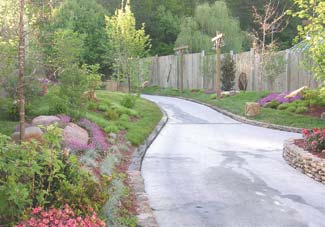
Recently, a new area was installed at the parkÑThe Thunderhead. Since the ground is sloped itÕs been a challenge for the staff. They also have to work around the large wooden rollercoaster that was put in last year. In addition, as the Thunderhead area was expanding and developing, they put in a new 400-foot long pathway extending from the rest of the park to the new rides and attractions. The path itself is poured concrete, and a mold was used to give it an old-fashioned Ògranite/slateÓ look.
The challenge was to develop and try to keep the path separated from the driveway by a hillside of dirt planted with trees and shrubs. ÒThunderhead is sort of like what an East Tennessee saw mill and lumber camp would have been like in the mid 1800s to early 1900s,Ó says John White. ÒRecreating that kind of feel meant we didnÕt want the landscape really manicured, because it wouldnÕt fit in.Ó The area around it is Victorian and very manicured so it was important that the transition mirror the change. However, there was a problem. ÒThe guests started wearing the plantings down to the dirt. This is not a straight walkway,Ó says John White. ÒIt meanders back and forth, and so, of course, guests tried to cut across the landscaped areas. So we had to figure out a way to keep them on the walkway.Ó
In areas where the guests wanted to walk off the pathway, the flattened, destroyed plantings created very obvious desire lines.
ÒWe watched the shortcuts,Ó says John, Òand then used big boulders to block them. Sometimes, we used some cedar splitrail fencing across a short section to block the flow of traffic. We also used full sized tree logs as barricades when necessary.Ó


Because they often have to redo areas, itÕs necessary to take out trees occasionally. Even though theyÕd rather not, the staff tries to maintain as much as they can. ÒWe use the one to seven ratio,Ó says Pat Edmonds. ÒThat means when we take out one tree we add seven to replace it in other areas of the park. Last year at Country Fair we ended up adding well over 100 trees more than what we took out.Ó One to seven is the parkÕs own way of being good stewards and ensuring they arenÕt a clear cutting company. ÒWe like to plant oaks and sycamores, tulip poplars, elms and maples,Ó says Pat. ÒMaples are great for the color in the fallÑand of course, dogwoods with their beautiful flowers are a favorite.Ó
Even though there are so many themed areas, buildings, attractions and rides spread across the 125 acres, the budget for maintaining a park of this size and complexity is relatively smallÑonly a half a million dollars. However, by working with the staff creatively, and using their heads, Pat Edmonds and John White can do an excellent job on a shoestring and show charming results every yearÑand with a healthy dose of good old-fashioned Southern Hospitality.
The Dolly Parton Rose Bed is located in DollywoodÕs Showstreet area. ÒThis is an ideal location for a rose garden,Ó said John White, DollywoodÕs Director of Maintenance and Construction. ÒIt offers excellent visibility for our guests to enjoy the roses while also providing good sun which is essential for the growth of the bushes.

The Dolly Parton Rose is not only remarkable for its spectacular color, but the rose is most fragrant when it is in half bloom,Ó White said. ÒIt is also a repeat performer, so the rosesÕ blooms contribute to the parkÕs beauty throughout the summer season.Ó The first blooms will appear in June before the roses reach maximum color in July.
ÒWhile weÕve planted Dolly Parton roses before, we have never had a single bed in the park dedicated to showcasing them,Ó said John White, DollywoodÕs Manager of Creative Projects. To keep the roses in pristine conditionÑworthy of their namesakeÑa rose specialist works with Dollywood’s landscapers throughout the winter, instructing them on how to best care for, nourish and grow the popular flower. The flowerÕs namesake is quite the fan, as well. ÒI have a yard full of Dolly Parton roses myself. Not just because theyÕre named after me, but because theyÕre beautiful,Ó Dolly said.
DollyÕs uncle Bill Owen is growing a chestnut forest on a hillside just outside the park area. According to the American Chestnut Foundation, prior to the chestnut blight, one in four hardwood trees in Pennsylvania was a chestnut. Mature chestnuts averaged up to 5 feet in diameter and grew to 100 feet tall, and many specimens reached 8-10 feet in diameter. Wildlife from birds to bears and squirrels to deer depended on the tree’s abundant crops of nutritious nuts.

The tree was one of the best for timber, according to the foundation. It grew straight and often branch-free for 50 feet. Loggers tell of loading entire railroad cars with boards cut from just one chestnut tree. Straight-grained, lighter in weight than oak and more easily worked, chestnut was as rot resistant as redwood. It was used for virtually everything—telegraph poles, railroad ties, shingles, paneling, fine furniture, musical instruments and even pulp and plywood.
