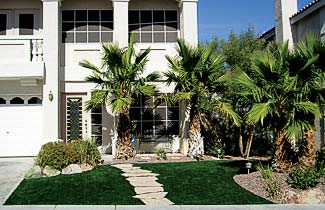
TheyÕre the new ÒTurf Wars.Ó Debates are cropping up all over as to whether artificial turf or the tried-and-true green make the better choice. Most newspaper and television news features focus on artificial turf used for athletic fields, but similar debates take place closer to home. Take the case of the Northport, Ala. homeowner who made headlines this spring when she ripped out her lawn and laid down a carpet of synthetic turf. ÒAt first, there were a lot of comments about it,Ó Margaret Burleson told a local paper. ÒDifferent people thought it was crazy. Some even went to city hall to try to do something about it.Ó BurlesonÕs neighbors took no action in the end, but a man in Marco Island, Fla. found himself in a pickle last December when he put down a layer of modern ÒinfillÓ synthetic turf. Resident Ed Ehlen had installed the new kind filled with rubber particles (which simulate the feel and traction of real grass).
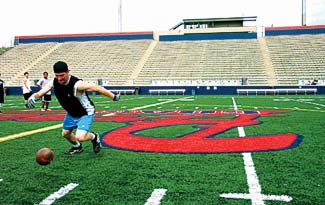
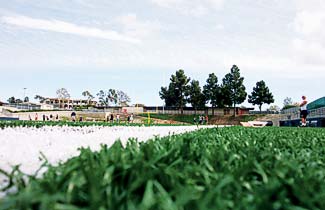
A player scrambles for a punted football on a recently-installed FieldTurf playing surface at Orange Coast College in California. A major advantage of artificial turf is durability, letting the team practice at the same venue where they play regular-season games, coaches and players report.
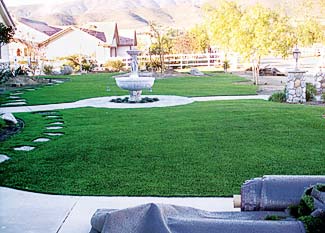
EhlenÕs community denied permits for his home out of concern over the spread of the rubber particles (an issue that has rarely come up elsewhere).
Ehlen paid close to $20,000 to install his yard of dreams. The solution is Òjust environmentally friendly,Ó he said. ÒYou donÕt have to water. You donÕt have to fertilize. ThereÕs a lot of good things about it.Ó
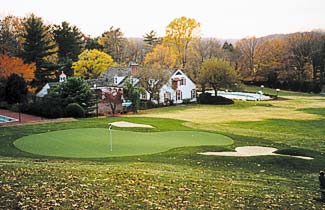
Polyethelene grass is growing even faster out west, where drought and water restrictions make it one of just a few options in communities surrounding Las Vegas, Phoenix and other cities. At Sunset Hills Memorial Park in the California desert, the dearly departed are protected by plastic green. And all over the country, synthetic turf putting greens are taking off because of their consistency and ease of maintenance.
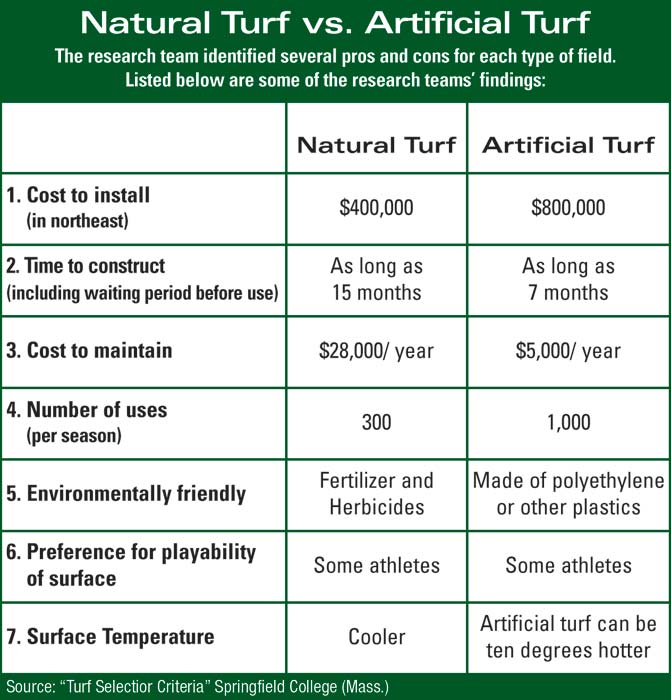
There are no scientific evaluations of the merits of artificial turf in residential settings, but several studies have compared natural and synthetic products for sports use. One of these was conducted at Springfield College in Springfield, Mass.
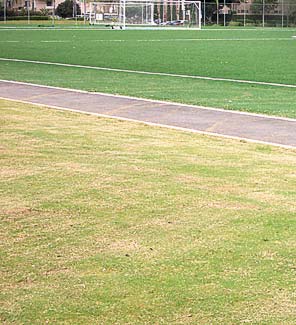
While the Springfield study focuses on turf choice for athletic use, some of the same considerations hold true for a residential setting. The most important is probably cost. Artificial turf represents a high initial investment, but will end up saving a property-owner over months and years for saved maintenance. And artificial turf, of course, will be preferred in municipalities with severe irrigation and planting restrictions.
Finally, it makes sense to carefully weigh the pros and cons before deciding which variety of turf to install.
Turf expert A.J. Powell of the University of Kentucky completed a thorough cost analysis earlier this year. While PowellÕs analysis is made for the sports-field professional, some of the same principals hold true for the home and property-owner.
The complete report is available at http://www.athleticturf.net Search the site for Òsynthetic turf.Ó
Powell concludes that the new artificial surfaces are more durable than natural turf fields but also more expensive that natural-soil-based turf. Powell made his conclusions clear at this yearÕs Sports Turf Managers Association annual conference in January.
ÒPurchasing an infill system makes no sense if you have a natural-soil field that is still safe, but just showing some wear,Ó he said. ÒIt especially makes no sense if you are spending nothing on maintaining the natural-soil field. In many cases, institutions are insisting on purchasing synthetic fields for purely aesthetic reasons, (or) to just keep up with the Joneses.Ó
ÑErik Skindrud, regional editor
Artificial turf is generally made of green-colored polyethylene or polypropylene fiber in two-inch piles. The fibers are tufted into a porous backing surrounded by a layer of silica sand and rubber bits. The height of the blades can be adjusted depending on certain specifications. A drainage system is developed under the soil through either crushed stone or perforated backing of the carpet. The composition of the infill is an important characteristic of turf to examine when considering which product/company will develop and install the project. Some in-fills are made up of only rubber while others consist of a rubber and sand mixture.
Criteria that are important to consider when selecting turf products are physical properties, the function of cost, performance and business/company relations. Important physical characteristics to examine include pile height, tuft bind, face weight, fiber denier, needle gage, in-fill composition and abrasion factors. Maintenance requirements of the artificial field and cost of installation and production are also important factors to consider. From a performance standpoint, characteristics such as plowing durability, bacterial growth, and the length of time for use of the product, safety data, playability, aesthetics, drainage and the ability to use in inclement weather are all important to determine. Finally, the time needed to install, plus the warranty, reputation, experience, patent information, claims experience, financial stability, third party insured warranty, geographic location and the number of years the business has been available to consumers are all significant issues that can determine the success/failure of the installation and development of an artificial turf field.
Penn State University researched artificial turf and found that there are four main criteria associated with quality playing surface. The four factors inherent in a quality field are hardness: the ability of the surface to absorb impact energy created by a player; traction: the effect the surface has on the shoe-to-surface interaction; cultural practice: how the grass is mowed; and soil and water: how dry or wet a surface is determines cleat penetration and stability. Another researcher also reported that the only drawback of artificial fields is that synthetic turf has a temperature that is ten degrees higher than natural grass.
The decreased maintenance cost of artificial turf is an attractive benefit in comparison to the maintenance costs of natural grass fields. Natural grass is estimated to cost $3,500 to $10,000 per acre per year. An artificial turf field is estimated to cost $5,000 per field in maintenance costs each year. According to one study, another benefit of artificial turf is the reduction of injuries to athletes although there are no turf standards for safety measures. Artificial fields do not have holes and puddles that natural grass fields develop over time. Shock absorption is also considered to be higher in artificial turf. The playing field is also more consistent on artificial turf than on natural grass. A final benefit of artificial turf is that it allows for more competitions and practices than natural grass.
Directors of Athletics at NCAA Division III institutions located in the Northeast were given surveys to examine the factors that are incorporated in choosing an artificial turf system, or how they chose their artificial turf system.
Safety ranked most important when selecting an artificial turf system. Second was multi-sport usage, third was indicated by both durability and drainage. Fourth was represented by both warrantee and physical properties and the fifth most important ranking when selecting a synthetic turf system was lifetime of product.
Among all the colleges and universities surveyed, safety was the number one criteria for selecting turf. Based on the research completed by the Springfield College team, the best choice for a synthetic turf application is FieldTurf. The FieldTurf product has a base made of cryogenic rubber and sand infill. This infill provides a more stable and safer grass-like material for athletes to compete on. The cryogenic rubber is rounded compared to jagged rubber used by other turf installers. This helps the rubber stay settled and not float around in areas of high use. When combined, all these factors add up to a safer playing field with less chance of injuries.
Multi-sport usage, durability, drainage, warranty, physical properties and lifetime of the product were the other top factors directors should consider when deciding on a turf application.
Warranty is important with a product like a turf application because it is an expensive investment that you hope will provide years of playability for athletes.